
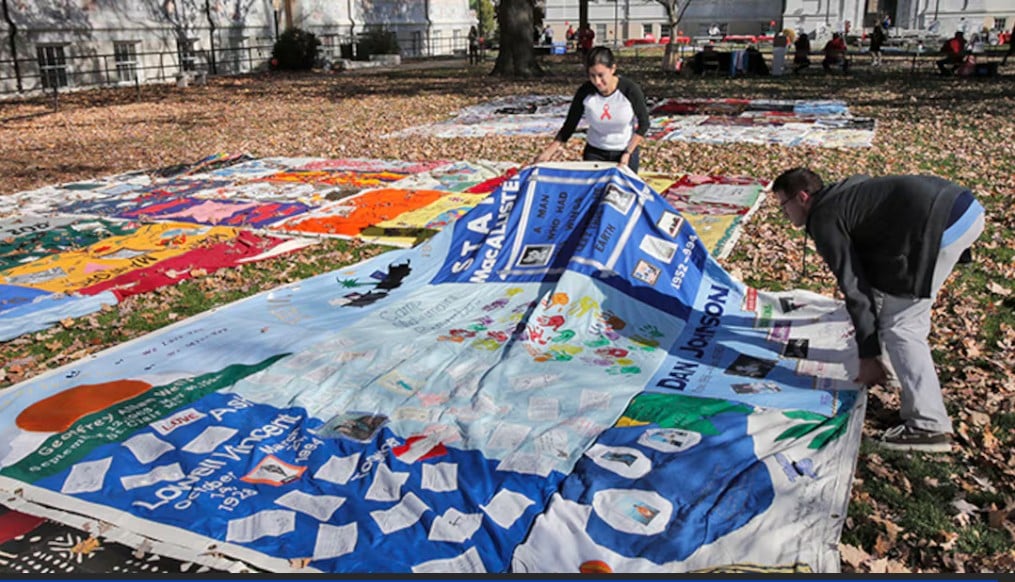
Nina Martinez (left), an AIDS advocate, and Roddy Williams, AIDS Quilt director of operations, straighten a section of the AIDS Quilt last December at Emory University. (Bob Andres/AJC)
(This op-ed appeared in the Atlanta Journal Constitution on June 4, 2026.)
This Friday, June 5, is a sober anniversary in the history of the HIV/AIDS epidemic.
It will mark exactly 45 years since the publication of the first medical report of what would become known as AIDS. Since then, more than 44 million people have died of the disease worldwide.
That statistic is really personal to me. I was diagnosed with HIV in 1985, long before effective treatments, when having HIV was an almost certain death sentence.
My survival has hinged on breakthroughs in treatment research, certainly, but I am also alive because of government safety nets that saved me when both my health and finances collapsed as I struggled with my diagnosis.
Today, I am filled with a familiar, unsettling dread. Washington is playing politics with lifelines that keep vulnerable Georgians alive.
Federal dollars for Medicare and other vital health and social services programs to help vulnerable Georgians await the federal chopping block.
The so-called “One Big Beautiful Bill Act” ax will fall on them only after this year’s midterm elections – a calculated political ploy intended to minimize voter backlash.
An estimated 550,000 people in our state have already dropped their health insurance entirely after federally funded subsidies for the Affordable Care Act (ACA) ended. More federal funding cuts are on the way.
When hard-working people are forced to choose between a roof overhead, buying groceries, and paying for the sudden spike in their ACA insurance premium, healthcare coverage will lose.
The consequence of untreated illness will present itself in emergency rooms and county hospital beds where it will cost taxpayers more than if treated earlier. Many of our healthcare systems already struggle to stretch resources.
My life as a person living with HIV is a testament to progress — and a warning about what happens when health disparities go unchecked. Only five years ago, COVID exposed public health failures once again, and millions more died. We all must act now to stop the dismantling of programs that save lives every day.
I am part of a group of local advocates participating in a national movement, called “Seven Days in June,” to promote public health and raise awareness about the danger of looming federal funding cuts.
We will host an event on Oak Hill in Piedmont Park on June 5 at 7 p.m., where speakers will lay out the stakes of the healthcare and affordability crisis we are facing.
The event will end with a candlelight vigil to honor those who have been lost in the 45 years of the HIV/AIDS crisis — as well as those who will die for any number of reasons as a result of the dismantling of social safety net programs and access to healthcare.
The program will include former employees of the Centers for Disease Control and Prevention (CDC) who lost their jobs during cuts that have damaged our national response to emerging outbreaks and disease.
My survival is the direct result of a compassionate society that decided my life, and the lives of thousands like me, have value. Sadly, it is difficult to imagine who, exactly, lawmakers value except themselves.
Please join us this Friday at 7 p.m., and help reverse the frightening direction our public health response has been taken.
(Mark S. King is an HIV activist and writer of the GLAAD Award-winning site, My Fabulous Disease.)
0 Comments