
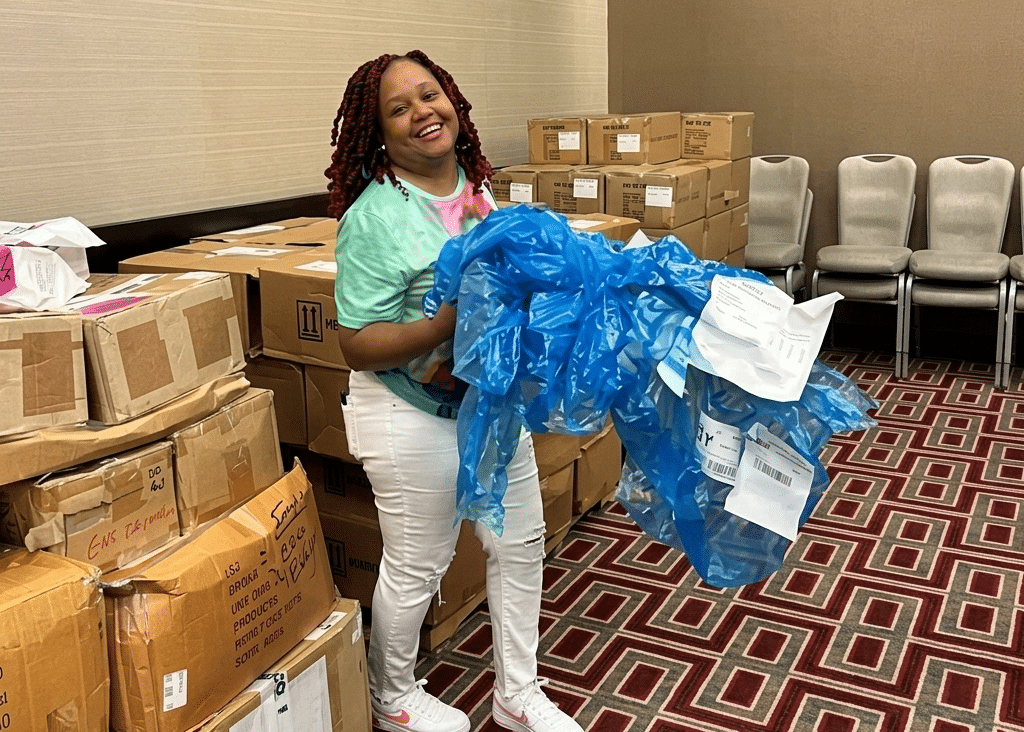
Diane Ferguson knee-deep in conference bag stuffing at USCHA 2025.
The United States Conference on HIV/AIDS (USCHA) is the largest conference in the country that brings together public health folks, activists, people living with HIV, and community organizations. It will be held in Anaheim, September 17-20, 2026 and has the theme, “United and Unbreakable: The HIV Movement at 45.”
It is the biggest opportunity we have to come together as people devoted to ending HIV and providing comfort, care, and advocacy. Have you registered?
As an attendee since the early 1990s, USCHA is close to my heart, even if I grouse about this thing or that. Yes, the expense keeps too many people away, and yes, the imprint of its Big Pharma sponsors on its programming keeps my eyebrow firmly arched. But despite those inescapable realities, USCHA is the beating heart of our movement and of the communities we represent. I will be there with bells on.
Diane S. Ferguson serves as NMAC’s Conferences and Events Specialist, so you can just imagine her workload right now. Among her duties is the selection and procurement of the conference bag each year, something that may seem like a frivolous detail but speaks to the thoughtfulness with which each aspect of USCHA is handled.
I spoke with Diane about what is happening behind the scenes as NMAC prepares for their signature event of the year. Spoiler: I couldn’t help but ask about the bags.
Here is our conversation, gently edited.
Mark S. King: USCHA is around the corner. What is your stress or excitement level about now?
Diane Ferguson: I’m very excited but a little anxious and always a little nervous.
I don’t think we know much about all the preparation that goes into getting this conference off the ground. What kinds of duties are you responsible for?
Right now is about getting the accepted abstracts for workshops and institutes finalized. Then I create the agenda at-a-glance, and the agenda for the program book. And then I can put that information in the app, which I also coordinate.
You just rattled off a list of to-dos that would make any organizer a little crazy. That’s a lot.
Oh yes. It all begins with the theme from our CEO, Harold Phillips. We take it and run with it from there.
There must be armies of people putting various aspects of the conference together. From the outside, at least, it looks like a well-oiled machine. You’re already laughing, I can hear you.
There are four members of the conference team! But we also have three consultants and there’s marketing, of course, and development, which raises money for the conference. In total, it’s about 15 people who put this on, but the core team is four people.
I’m a little stunned by that.
Conference planning had only three people before I came along. When I came to NMAC in 2018, I was in development for four years and then moved over to the conference.
I don’t know why I am obsessed with the conference bags, maybe because I have collected them and I always look forward to the next iteration. And it is just one example of the thoughtfulness that is required when making important choices.
I started choosing the bags four years ago. Alison McKeithen, our former Assistant Director, encouraged me to use fair trade organizations to purchase the bags.
What’s a fair trade organization?
It’s an organization that is usually overseas, and they make the bags inexpensively by workers in that country.
Why is that important?
We give women – it’s usually women – in other countries an opportunity to make money.
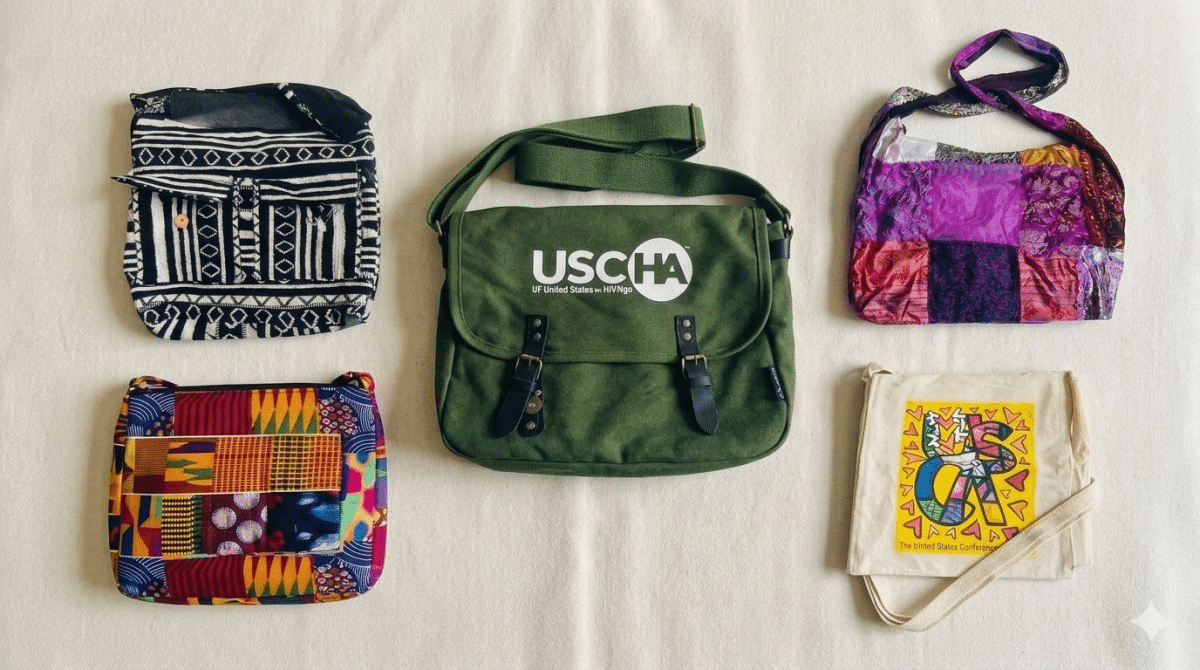
USCHA conference bags from over the years.
And the bags have come from some very far flung and exotic places.
The 2023 conference bag, the quilted patchwork bag, came from an organization named Jorova, in Kenya. The patchwork crossover satin bag from 2024 was made in Nepal. The khaki satchel from 2025 came from a veterans-owned printing company in the United States.
Is there a message you are trying to deliver by what you choose?
I want to give participants a unique gift, something they can use outside of the conference. Something fun that can be a conversation piece.
The bag last year, the canvas satchel, was positively chic. That’s not something one would expect from a conference tote.
No. I thought it was pretty cool. We got a lot of compliments. It was one of the most useful bags we have ever had.
Tell me about the selection of the 2026 bag.
The 2026 bag is a little more basic because of budget constraints. I think it’s a very practical bag and can be used outside the conference. It’s a tote.
I can’t help but think that, intentionally or not, the simplicity of the bag this year speaks to our country’s overall climate, with budget cuts and people choosing practical over whimsical.
Right.
You lost a beloved member of the NMAC family last year.
Yes. Tara Barnes was the conference director, and she passed in November of 2025.
I know there’s a remembrance event at USCHA this year, and that she will be remembered as part of the community we have lost, which is lovely and sad.
Yes, it is.
Paul Kawata looms large over NMAC and USCHA. How has it been creating the conference for the first time since his retirement as head of NMAC last year?
It’s been somewhat of a challenge. We had Paul and Tara’s past experience and history with USCHA. But we are overcoming those challenges. We’re working hard to make USCHA the best it can be.
No panicked calls to Paul’s cell phone? Or is he happily free of devices since retiring?
He still has his cell phone! I’m sure he gets an earful. I text him to say hi. But no, no panicked calls to Paul.
The theme of USCHA this year is about the fact that our HIV public health crisis has now turned 45 years old. That’s a lot of history and trauma and community building. Can you tell me how that will play out at the conference this year?
A big part of our workshops and themes is about storytelling. People have a lot of stories and thoughts and memories and things to say. We want there to be a space for people to communicate what it has been like for the last 45 years.
Where will you be stationed once the conference is underway? It is just nuts for you?
I will be all over the place with roller skates on. But my main location will be in the conference operations office, in the Palisades Room.
Are you sure you want to advertise your location?
It’s fine. I’m on the fourth floor.
So you’ll be putting out fires up there.
Oh yeah. People say their event rooms are too cold, or not big enough, or their slides don’t work…
If anyone comes to you to say their workshop room is not big enough, for crying out loud, please send them directly to me so I can take a swing at them with my conference bag.
Look, some workshops have to be in smaller rooms. Hopefully, we make the right decisions about who goes where.
Can you tell me something about USCHA that you are really looking forward to?
The Welcome Reception on Wednesday night! It’s going to be on the terrace level, but I am sworn to secrecy about the details.
I am sneaking off to Disneyland that day. I can’t help myself.
But you gotta come to the welcome reception! It starts at 5:00. Please come.
Okay, but I might still have my Mickey Mouse ears on.
Okay.
Thank you so much for your work, and please share that with everyone at NMAC. We appreciate you. We count on you.
You are very welcome.
Mark

0 Comments