
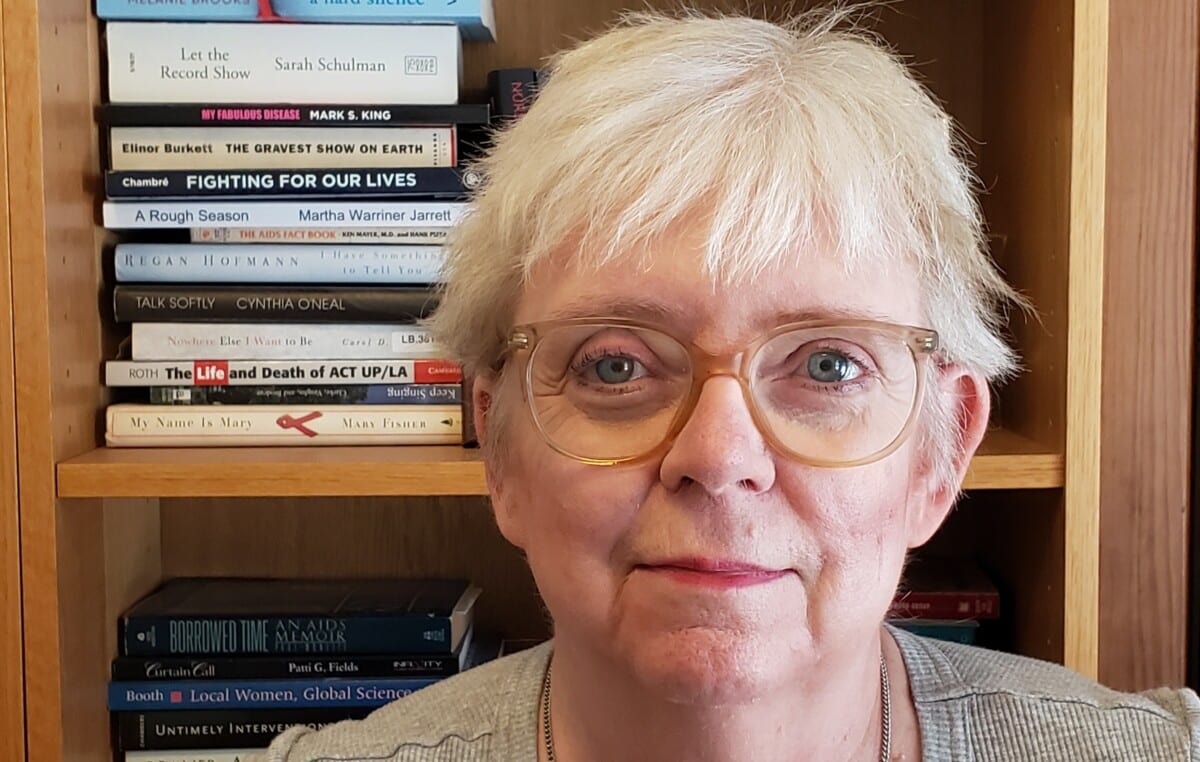
Unstoppable: Straight Women at the AIDS Frontlines, written by author and activist Victoria Noe, is a powerful book that documents the vital and often overlooked work of straight women in the HIV/AIDS epidemic. The book serves as a follow-up to her award-winning 2019 release, Fag Hags, Divas and Moms.
Victoria “Viki” Noe, in other words, won’t stop talking about straight women. You would think their contribution to the tapestry of HIV history would be a given. As Viki explained to me in our conversation below, it is not.
Something that has always struck me about Viki is her devotion to the HIV community despite her sometimes feeling apart from it, like a child peering in the window of a store she isn’t allowed to enter. Maybe that’s what brings a tinge of sadness to her work: the fact she has to chronicle these stories, very specifically, at all, and then be given side-eye for doing it.
People constructed roadblocks to Viki’s work, but she persisted. Most troubling of all, the resistance to centering women in the history of HIV didn’t end when she successfully published these books. You’ll hear more about that in our conversation, too.
Despite it all, Unstoppable is an engaging work of history, remembrance, and victory. Read it.
Here is our conversation, lightly edited for clarity.
Mark S. King: Well here you are again, talking about straight women. It’s your niche, and to say it is a niche topic proves your point about the underreporting of straight women in the HIV fight, doesn’t it?
Viki Noe: Forty years ago, the conversation was about gay men and babies. Straight women were only talked about in connection with babies. Passing HIV to their babies. And obviously they had done something wrong to have HIV in the first place. Then it morphed into straight women as caregivers, which really oversimplified their involvement. I see it still.
And gay men don’t react well to that?
I’ve had young gay men criticize me for diminishing the impact on the gay community. One said I was erasing gay men from the story of the epidemic. I said you didn’t read the book did you? I am just widening the narrative.
Did you get any grief over including “fag hags” in the title of your first book about women in HIV (Fag Hags, Divas and Moms: The Legacy of Straight Women in the AIDS Community)?
A lot. My ads got taken down from Amazon. The women in the book wanted “fag hags” in the title. Generally, the criticism was coming from gay men. I pitched the book to agents, and this young gay agent said, “No one knows who you are, so you need to get a famous gay man to write the foreword.” Men thought I needed men to validate the book.
You would think that a community as outwardly inclusive as HIV/AIDS would have no problem highlighting women and their history. Or do I have that wrong?
There’s a tendency in the media to equate the month of June with AIDS, because of the anniversary of the first article (about what would become known as HIV), and Pride month. I’ve seen so many articles talking about pride and HIV. It’s not the same thing. To the media, it is. You wouldn’t do a story on women’s history and HIV, because to them those things don’t connect.
Within our HIV community, does this sexism and erasure of women exist?
Absolutely. I went to a World AIDS Day event. There were 11 speakers. Ten of them were gay men. I was not surprised.
Who was the 111th speaker?
A black trans woman. She was terrific. I talked to her afterwards. She knew she was being used to tick off a box.
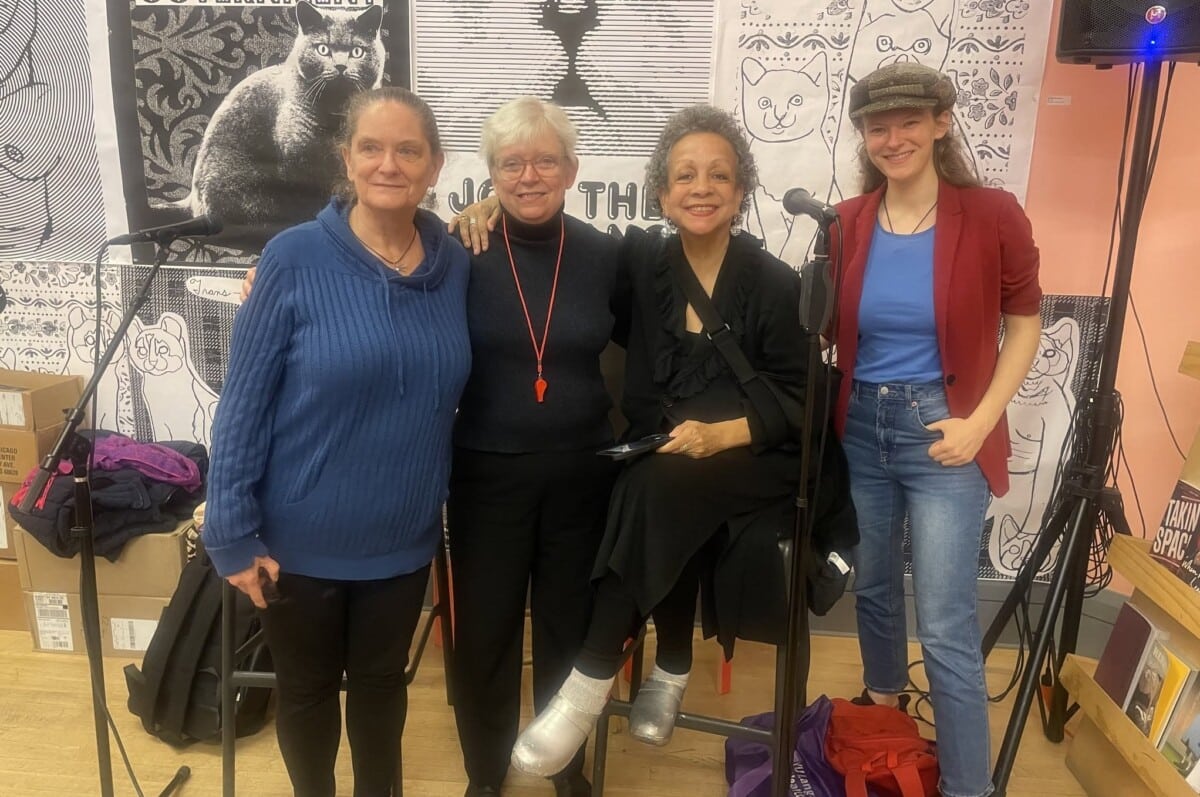
Martina Clark, Victoria Noe, Krishna Stone, and Maureen “Mo” Fenninger at a book event for “Unstoppable” in New York City.
Your new book doesn’t simply pick up where you left off. Five years have passed, including the beginning of a second Trump administration. That figures prominently in Unstoppable. How did it change the writing and the content?
Two years ago, I decided it was time to write another book about women. I assumed it would update some of the women’s stories. As we went through 2024, things started to shift. Women were concerned about the election, but during his first term he was behind ending the epidemic by 2030. I went back and re-interviewed some of the women I had interviewed for the new book, and they were freaked out. The anger in these women was overwhelming, and it was exhausting for me. I thought no one would read it. My editor said I would find a way to balance it. I found a way to use the anger and find hope. Some of the women actually had hope. They found hope in community.
In your essay, “It’s Not Just Grief,” for POZ Magazine in August of 2025, you write, “Anger feeds us, gets us moving, brings us together. It’s a response to injustice. It’s a response to helplessness. But beneath the anger is the undeniable reality of grief.” Society doesn’t like angry women, but you persist. What do we find so threatening about that?
The stereotype has been there a long time. Men are allowed to be angry. For women it’s unladylike. It’s a negative emotion. The anger was based in grief. It’s part of it. What we built has been taken away, and that’s a different kind of grief. I heard a woman talk once about the trauma of archival research. She listened to oral histories of the AIDS Memorial Quilt and the Veterans History Project. She was listening and reading, and she was not prepared for the emotions that she felt. Writing about women is about dealing with the trauma. My advice to anyone about writing about the epidemic is always, “Get into therapy first.”
But writing is my therapy.
Yeah. Me too.
What’s been taken away?
The services, the research, the access, the funding, things that we fought for years to get. Fighting for something that wasn’t there before is different from fighting to keep it from being taken away.
What stories are your favorites in Unstoppable among those you profile? Do not tell me they are all your literary children. You have to choose.
Martina Clark became her own chapter and that was not planned. To me, she embodied everything that straight women with HIV were going through. She struggled with disability, fighting for her meds. These are things women go through every day. She is one of the most powerful stories. Also, stories in a chapter about faith and religion. The stigma is still there today.
It’s hard for gay men like me not to feel defensive about all this.
I know.
Maybe we’ve gotten used to being king of the mountain, and you want to topple us off. But that’s also very male, isn’t it, framing it as “us versus them.”
It is. I have faced that in the community since at least 1989. It shocked me at first. Most of the men I knew at the time were gay. I have never tried to take anything away. That’s not the point of what I do. The point is to say, “We’re here, too. We are part of this community, too.”
I’m trying to think of HIV stories in arts, movies or literature that center women. Rebecca Makkai does it in her novel, The Great Believers. And Sarah Schulman certainly addresses the erasure of women from AIDS activism in Let the Record Show. Beyond that I‘m coming up empty. Women are usually relegated to the role of grieving mom.
The books about women tend to be only memoirs. There’s a great documentary, Nothing Without Us, about women and HIV in Africa. I think it’s the only one I can find. Rebecca did her research. Her female character just gutted me. But they don’t have to be books. They can be short stories, or documentaries, or Substacks. I am constantly encouraging women in the community to tell their story. People inside and outside the community need to hear their stories.
Now that you have two books under your belt about straight women, what’s next?
I’m having both books translated into Spanish that will come out next March. I did research, and few books about the epidemic are available in Spanish. Later this year I’m starting a podcast, “Unstoppable Women.”
I did not think I would still be talking about this 45 years into the epidemic. I don’t take the dismissal personally anymore. I wish that young gay men, in particular, when they learn about the history of the epidemic, they learn it’s not just about them.
Thanks for helping to preserve important history, Viki. It means something. Do you really know that?
Not every day. But most days I do.
Mark
p.s. The countdown has begun! Watch for my coverage of AIDS2026 in Brazil next week, appearing on my site and with additional exclusive coverage appearing on POZ.com and PositivelyAware.com.
“Great interview! I will read the book. As an HIV+, straight woman, this interview hit a cord because, in the late 80s, I sought knowledge about the disease that was killing me and so many others, but at that time the venues for women were somewhat limited to emotional support groups–not what I was looking for. In 1990, I discovered the PWA Health Group in Manhattan, founded by a firebrand doctor and two of his HIV+ patients: Dr. Joseph Sonnabend, Michael Callen & Thomas Hannan. The Executive Director at that time was the inimitable Sally Cooper who started a couple of women-centric projects there. She invited me to attend “The Women’s Treatment Project,” a bi-weekly, round table meeting where speakers recruited (by Sally) gave talks on various HIV research topics and lively discussions ensued. A cherished memory is of Tim Horn, who was severely weakened from battling lymphoma at the time, coming to give prepared, science-based talks. To my knowledge, there were several regularly attending women from that project, that went on to found HIV organizations and significantly contribute to AIDS activism and advocacy. I had the opportunity to meet and work with some of the early Act-Up members through my role as editor-in-chief of Infopack, an HIV treatment periodical produced by the Community Prescription Service (CPS), a pioneering mail-order pharmacy business founded in 1991 by prominent AIDS activists Sean Strub and Stephen Gendin. Stephen was my mentor and the first editor-in–chief of Infopack, and I took over that role in the mid-90s. We recruited writers from a literal who’s who of HIV treatment activists, most of whom were GWM, to write the well-researched and sourced articles. I owe Stephen and many others the life I have today. My role as editor gave me access and seats at tables I never would have been invited to otherwise. With the notable exceptions of Bob Munk, Jules Levin, and Tim Horn, I always knew that my being at various tables was only tolerated by most of the GWM treatment activists. It pleases me to think that straight women’s contributions to AIDS activism will be remembered but suspect that only straight women feel that way. PS: HAG is an acronym for HIV & Aging Group on facebook, and when I started that group, still active today, I received significant push back about the word “HAG”—-but mostly from women. https://www.facebook.com/groups/79210965487
Thank you so much for this, Mark! It was a pleasure as always to chat with you. Here is the link to information on the Spanish translations of my two books: https://www.nyfa.org/projects/project-info/?id=VN2102
Terrific interview — but why not, considering the interviewer & the interviewee. Thanks to you both. — Jim Eigo